
US President Donald Trump announced a finalised peace deal between the US and Iran, set for signing on June 19 in Switzerland, with key figures like J D Vance, Steve Witkoff, and Jared Kushner from the US side, and Abbas Araghchi and Mohammad Bagher Ghalibaf representing Iran, alongside Pakistani mediators Field Marshal Asim Munir, Shehbaz Sharif, Ishaq Dar, and Mohsin Naqvi, playing crucial roles in the diplomatic breakthrough.

Pakistan has intensified its efforts to bring the US and Iran back to the negotiating table to end the war in West Asia, following President Trump's extension of the ceasefire. Pakistani officials have engaged with Iranian, Turkish, and British counterparts to promote dialogue and diplomacy for a peaceful resolution.

US President Donald Trump threatened to bomb Iran if a deal is not reached before the ceasefire ends, while Pakistan urged both sides to extend the truce and pursue diplomacy.

Iran has presented a multi-layered proposal to the US in an attempt to break the deadlock in peace talks, focusing on de-escalation and nuclear programme discussions.

National Conference President Farooq Abdullah has voiced his concern over the escalating violence in West Asia, urging all parties to prioritise dialogue and diplomacy to de-escalate tensions and protect civilian lives.

Pakistan is set to host face-to-face talks between the United States and Iran, aiming to solidify a fragile ceasefire and prevent further conflict in West Asia. The discussions will focus on a long-term peace arrangement, including sanctions relief, regional security, and Iran's nuclear program.

The BRICS foreign ministers' meeting in New Delhi concluded without a joint statement due to disagreements over the West Asia conflict, with Iran blaming the UAE for the lack of consensus. India, as the host, issued a chair's statement highlighting the differing views.

Amid rising tensions in West Asia, China is urging all parties to cease military operations, following Trump's appeal for help in securing the Strait of Hormuz.

India's handling of the Iran crisis reflects a growing strain between strategic autonomy and geopolitical alignment, observes Ambassador M K Bhadrakumar.

The pause gives the US time to breathe, to regroup, to move its expeditionary force into position without risk of interception along the way. It gives Iran nothing -- on the ground, attacks against its infrastructure continue apace. Prem Panicker in his must read daily blog on the Gulf War.
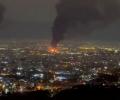
To be sure, Trump is furious, as the trajectory of the war is in a state of Zugzwang, as chess players call it. Trump and Netanyahu stare at two choices -- retreat in humiliation and concede Tehran's demands -- recognition of its rights, reparations, and binding security guarantees -- or perish in a quagmire, points out Ambassador M K Bhadrakumar.

Karex, the Malaysian company that makes roughly one in five of the world's condoms -- about five billion a year, supplying Durex and Trojan among others -- announced this week that it is raising prices by up to 30 percent. The reason is the Strait of Hormuz.
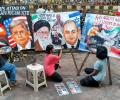
Prime Minister Narendra Modi on Sunday conveyed to Iranian President Masoud Pezeshkian India's 'deep concern' over Iran's conflict with Israel and called for immediate de-escalation of the situation through 'dialogue and diplomacy'.

'We were in a heavily nuclearised environment. China had tested for Pakistan in the 1980s and helped their missile programme stay just one step behind us.'

The LPG squeeze on India's restaurant sector is the quotidian face of a deeper crisis.

'The BNP's election manifesto lists grievances against India, mirroring the attitude of past BNP governments.' 'Political parties have been careful not to say bad things about China.'
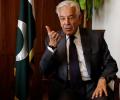
Pakistan's Defence Minister Khawaja Asif has warned that Islamabad will enter into an 'open war' with Kabul if the ongoing peace talks in Istanbul fail, TOLO News reported.
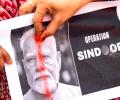
World leaders, including the UN Secretary-General and US President Donald Trump, have urged India and Pakistan to exercise restraint and seek peaceful solutions to the ongoing tensions. The calls for calm come after India conducted airstrikes in Pakistan-occupied Kashmir in response to a recent terrorist attack. Leaders from the US, Russia, UK, China, UAE, Qatar, and Japan have expressed concern over the escalating situation and emphasized the need for dialogue and de-escalation.

We have nothing to gain by raising our concerns internationally as our narrative has got entangled with several controversial concepts in the United Nations, asserts Ambassador T N Sreenivasan.

United States Charge d'Affaires Natalie Baker on Wednesday met Deputy Prime Minister and Foreign Minister Ishaq Dar as part of efforts to de-escalate tensions with India following the Pahalgam terror attack on April 22 in which 26 people were killed.
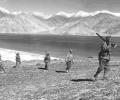
As India and China continue to face off across the Himalayas six decades later, the echoes of that earlier conflict remain unmistakable. The core of China's sensitivity lies not in maps or mountain passes, but in its perception of sovereignty over Tibet, points out Dr Kumar.

In retrospect, it appeared that the bitterness of the war was still strong and the Ukrainian success in occupying Russian territory just a few days ago had added to the complexity of the situation. The positive US response to the visit, however, remains a silver lining in the dark clouds, notes Ambassador T P Sreenivasan.
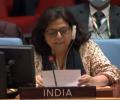
India hit back at Pakistan in the UN Security Council after Islamabad raised the Kashmir issue at the 15-nation Council.

India supports dialogue and diplomacy and not war, Prime Minister Narendra Modi said at the Brazil, Russia, India, China, South Africa (BRICS) Summit in Kazan, Russia on Wednesday, in an unambiguous message calling for resolution of the Russia-Ukraine conflict through peaceful negotiations.

We have already suffered considerable collateral damage as a result of the war, and its continuance will continue to dampen our prospects for faster economic growth. We have a direct and legitimate interest in its early cessation, counsels former foreign secretary Shyam Saran.

'Instead of fighting over whatever will be left of the present world, the permanent members of the UN security council should have raised a little finger to arrest the death and devastation around us,' notes Ambassador T P Sreenivasan.
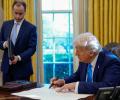
The stage may be set for a recalibrated US-Iran relationship, suggests Ambassador M K Bhadrakumar.
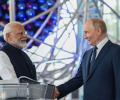
Prime Minister Narendra Modi on Tuesday told Russian President Vladimir Putin that a solution to the Ukraine conflict is not possible on the battlefield and peace efforts do not succeed in the midst of bombs and bullets even as he flagged concerns over a missile strike on a children's hospital in Kyiv.

There is growing acceptance of the idea in the international community that engaging the Taliban government is a far better approach than ostracising it, observes Ambassador M K Bhadrakumar.

The 15-nation Council met on Friday to vote on the resolution tabled by the United Arab Emirates and backed by over 90 member states. The resolution got the backing of 13 Council members who voted in its favour while the United Kingdom abstained.

"I complimented him for his vision, for his courage in giving diplomacy yet another chance," Prime Minister Manmohan Singh told media persons in a joint media interaction with Obama inside the Oval Office of the White House, following an hour long meeting between the two leaders.

India abstained on the procedural vote taken in the Security Council ahead of a meeting to discuss the tense situation on the Ukraine border.

Prime Minister Narendra Modi said on Sunday said he views the current situation in Ukraine as an issue of humanity and human values and not of politics or economy even as he called for respecting international law, sovereignty and territorial integrity of all nations.

'If the jihadi infiltration attempts are assisted by the Pakistan army, the Indian Army will retaliate strongly.'

Brinkmanship in the Taiwan Strait will not only be a recipe for disaster to both China and Taiwan, but also to international peace and stability, warns Rup Narayan Das.
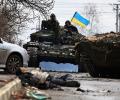
Tirumurti said India continues to remain deeply concerned at the worsening situation and reiterates its call for immediate cessation of violence and end to hostilities.

'In today's world, it is difficult for public pressure to work against a country like India.'

'...to prevent this episode from disrupting ongoing cooperation.' 'The discovery of this plot had the potential to derail much of what has been achieved in the relationship during this administration's tenure -- I don't think that fact has been sufficiently appreciated in India.'
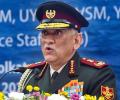
He said the aim has been to create firewalls to deal with the cyber attacks and that the issue is being addressed in a "serious way".
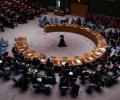
India abstained from a procedural vote taken in the United Nations Security Council to call for a rare special emergency session of the UN General Assembly on Russia's aggression against Ukraine, even as New Delhi welcomed Moscow and Kyiv's decision to hold talks at the Belarus border.
